Self-Managed Micro-Integration Architecture
A Micro-Integration is a lightweight, event-driven integration module that moves data between an external system and a Solace event broker. Each Micro-Integration is purpose-built for a specific system and data direction, keeping integrations narrowly scoped and independently manageable.
Workflows
Each Micro-Integration runs one or more workflows. A workflow is a data path through the Micro-Integration and has a single direction: it either consumes from a source or produces to a target, not both. A Micro-Integration can include workflows in either direction, if the Micro-Integration supports both. A single Micro-Integration deployment can run multiple concurrent workflows (usually up to 20, although the exact limit can vary. See the specific Micro-Integration's overview topic to confirm).
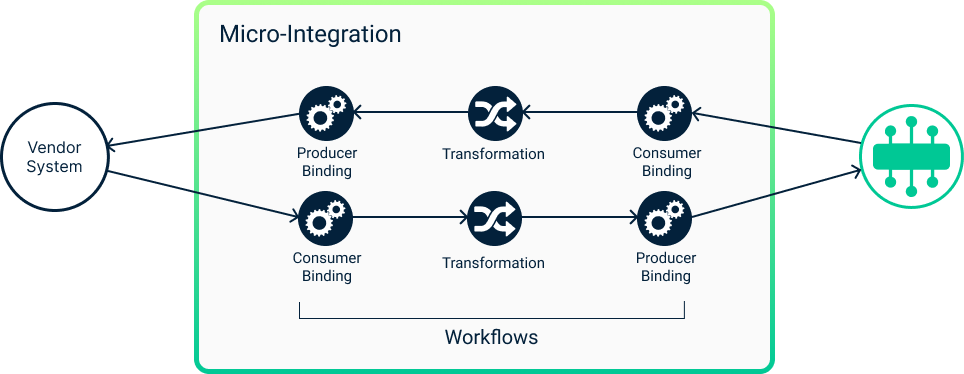
Each workflow consists of the following parts:
- Consumer binding
-
The consumer binding connects to the source system and reads messages from it. For event broker sources, the consumer binding reads from a queue. For external system sources (such as databases, file systems, or messaging services), the consumer binding uses a protocol specific to that external system.
- Transformations
-
Every workflow can include a transformation step, whether it connects to an external system or moves data through the event broker itself. A transformation is an optional step between the consumer and producer bindings. Transformations map source header and payload fields to target header and payload fields, and can also apply functions to those fields. If you do not configure transformation, the Micro-Integration forwards the message as-is. For more information, see Mapping Message Headers and Payloads.
- Producer binding
-
The producer binding connects to the target system and writes the message to it. For event broker targets, the producer binding publishes to a topic. For external system targets, the producer binding uses a protocol specific to that external system.
As shown in the following diagram, each workflow in a Micro-Integration has its own consumer binding, transformation, and producer binding. The diagram shows two workflows in the Micro-Integration, with one workflow going in each direction.
Binders and Bindings
Self-managed Micro-Integrations are built on Spring Cloud Stream. In this model, a binder is the generic, reusable connector code responsible for communicating with a specific external system or the Solace event broker; for example, the solace binder or a vendor-specific binder such as snowflake. A binding is a configured connection to a specific destination, such as a queue or topic, that uses a binder to handle the underlying communication.
Most Micro-Integrations use two binders: the solace binder for the event broker connection and a vendor-specific binder for the external system. Micro-Integrations that move data from the event broker, through a transform, and back to the event broker use only the solace binder; both the consumer binding and the producer binding reference it. You define binder configuration separately from workflow configuration in the application.yml file. For more information, see Understanding the application.yml File.